Free your labels: 5 steps to switch from barcode to enhanced QR code without errors
The transition from the EAN-13 barcode to the enhanced GS1 QR code (GS1 Digital Link) is not just a symbol change. It is a major standards evolution affecting product data, checkout systems, regulatory compliance, and industrial processes.
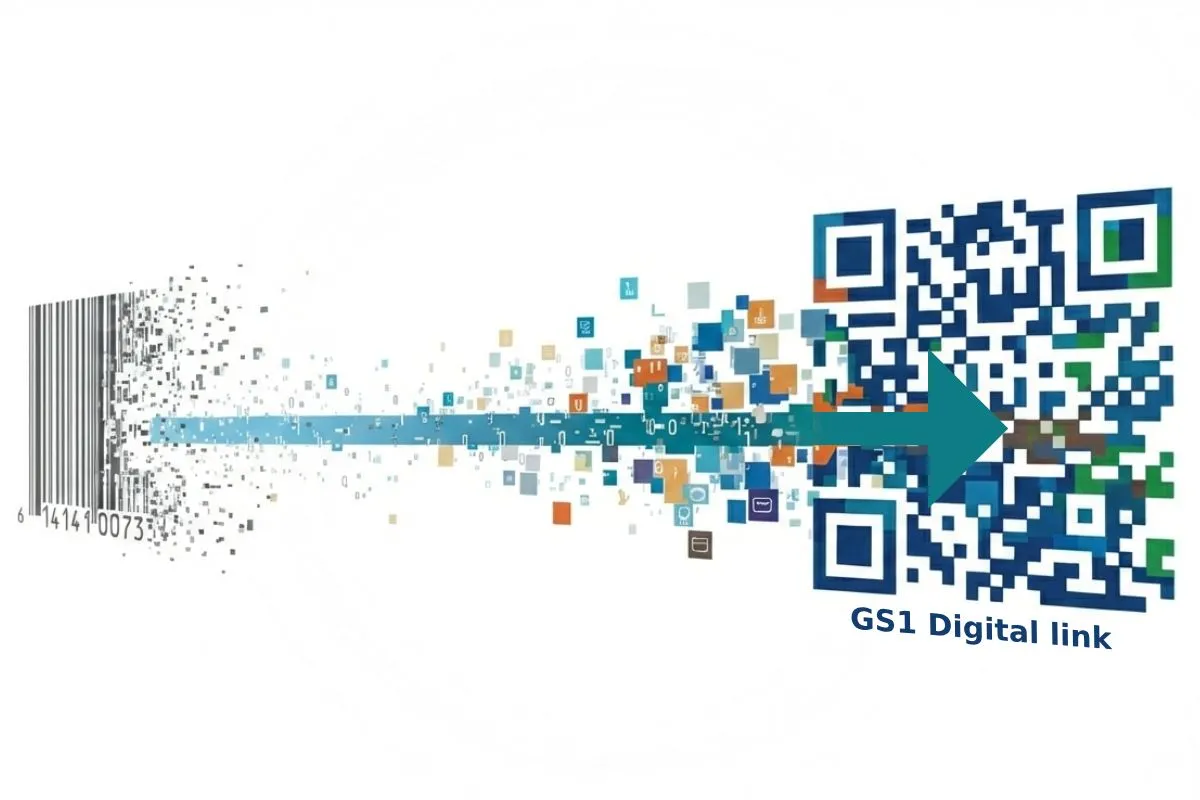
This guide is designed to provide a technical, standards-based, and actionable roadmap, aligned with GS1 standards and ISO norms.
Why the GS1 QR code changes the game, and why EAN-13 is reaching its limits
The EAN-13 barcode was designed for one single function:
Identify a product at checkout through a GTIN.
While it remains reliable, it is now structurally limited:
- Fixed data
- No extensibility
- No update capability
- No interaction with the consumer
The GS1 QR code (Digital Link) keeps that identification function while adding a smart data layer.
One single symbol can now enable:
- Checkout scanning (B2B)
- Access to product data via smartphone (B2C)
- The integration of traceability and safety information
This is not a marketing use case. It is a new industrial standard, built to last.
Step 1 - Audit and secure your master data
Every successful transition starts with an invisible but fundamental prerequisite: master data quality.
The GTIN remains the central pivot of the GS1 system. A QR code, even perfectly printed, will never compensate for:
- an incorrect GTIN,
- a duplicate,
- or data not registered in the GS1 ecosystem.
GS1 best practice
GTINs and their attributes must be:
- properly structured,
- kept up to date,
- registered in the GS1 Registry Platform.
Industrial benefits
- Securing checkout flows
- International interoperability
- Reduced logistics and retailer disputes
Step 2 - Define a compliant GS1 Digital Link URL architecture
GS1 Digital Link is not a free-form URL. It is a standardized data structure, designed to be interpreted by both industrial scanners and smartphones.
Canonical structure
https://[brand_domain]/01/[GTIN]Key Application Identifiers (AI)
- 01: GTIN (mandatory)
- 10: Batch number
- 17: Expiration date (YYMMDD)
- 21: Serial number
The central role of the resolver
The GS1 resolver allows differentiated reading:
- Checkout scanners extract only the identification data
- Smartphones access the adapted digital experience
Critical point of attention
The domain name must be:
- short,
- durable,
- controlled by the brand.
A URL that is too long increases QR code density and reduces checkout readability.
Industrial benefits
- A more compact and robust QR code
- Reliable reading on low-resolution scanners
- Durability throughout the product lifecycle
Step 3 - Design and print: comply with ISO standards
A GS1 QR code is a standardized industrial object, subject to strict physical constraints.
Essential requirements
- Recommended minimum size: 21.21 x 21.21 mm
- Quality standard: ISO/IEC 15415
- Quiet Zones are mandatory
- High contrast between modules and background
Watch out for common mistakes
Red is perceived as black by laser checkout scanners. A red QR code can become totally unreadable at the point of sale.
Industrial benefits
- Maximum readability rate
- Zero friction at checkout
- Reduced waste and reprint costs
Step 4 - Qualicode validation: secure before industrialization
Before any large-scale production, validation is essential. The Qualicode service from GS1 France analyzes:
- the real code size,
- contrast,
- ISO grade,
- multi-scanner readability.
An official compliance report is delivered.
Industrial benefits
- Standards and legal security
- Reduced retailer risk
- Validation before heavy industrial investment
Step 5 - Orchestration and dynamic data
The power of the enhanced QR code lies in the separation between the printed symbol and the displayed data. Thanks to GS1 Digital Link:
- the printed QR code does not change,
- the content can evolve in real time.
Industrial use cases
- Regulatory updates (AGEC, Nutri-Score)
- Product recall management
- Traceability information
- Content adaptation by country or channel
Industrial benefits
- No relabeling required
- Maximum responsiveness in case of incident
- Reduced non-quality costs
Security and serialization: a strategic lever
The GS1 QR code makes it possible to integrate critical safety data.
Example:
- AI 17 (expiration date) can automatically block an expired product at checkout.
Measurable benefits
- Reduced health risks
- Lower exposure to fines and recalls
- Better control of the downstream chain
Conclusion: a standards transition, not a gadget
Moving from EAN-13 to the enhanced GS1 QR code means:
- securing product identification,
- enriching traceability,
- preparing the industrial ecosystem for the 2027 deadline.
The players who approach this transition as a structuring, standardized, and anticipated project gain a decisive lead over those who simply endure it.